
Why Restaurant Marketing Attribution Is Still Broken in 2026 (And What It Would Take to Fix It)

A Shopify Store Knows Exactly Which Ad Sold That $34 Candle. Your Restaurant Can't Tell Which Ad Brought in Last Friday's 200-Person Night.
Same ad platforms. Same targeting tools. Same optimization algorithms.
Completely different results — and the gap has nothing to do with how smart you are at marketing.
You've run the ads. Watched the impressions stack up, the clicks roll in, the video views climb. Then someone asks the question every restaurant marketer dreads: "How many of those clicks actually became guests?"
And you pause. Maybe pull up a spreadsheet. Maybe offer a version of: "We think it's working."
That silence isn't a failure of effort. It's a structural problem that nobody in the restaurant industry has solved yet.
The E-Commerce Comparison That Breaks Your Heart
An e-commerce brand running ads can tell you — down to the penny — which ad generated which sale.
The reason is almost embarrassingly simple: they have one place where money changes hands. In 2013, Shopify launched their Facebook pixel integration — one checkout, one pixel fire, one clean data stream flowing back to the ad platform. By 2015, even a solo founder selling handmade soap could track which $5 ad generated which $34 sale. The machine learns who buys, finds more people like them, and gets sharper every day.
Restaurants in 2026 still don't have an equivalent. Thirteen years later.
A restaurant? Quick — off the top of your head, how many separate places does money change hands or a commitment get made at yours?
- POS (in-store transactions)
- Online ordering (DoorDash, UberEats, or direct)
- Reservations (OpenTable, Resy, or direct)
- Loyalty app (if you have one)
- Website (contact forms, menu views, direction clicks)
- CRM (if you're tracking leads at all)
Six tools. Six different companies. Six different data languages. Almost none of them designed to communicate with an ad platform.
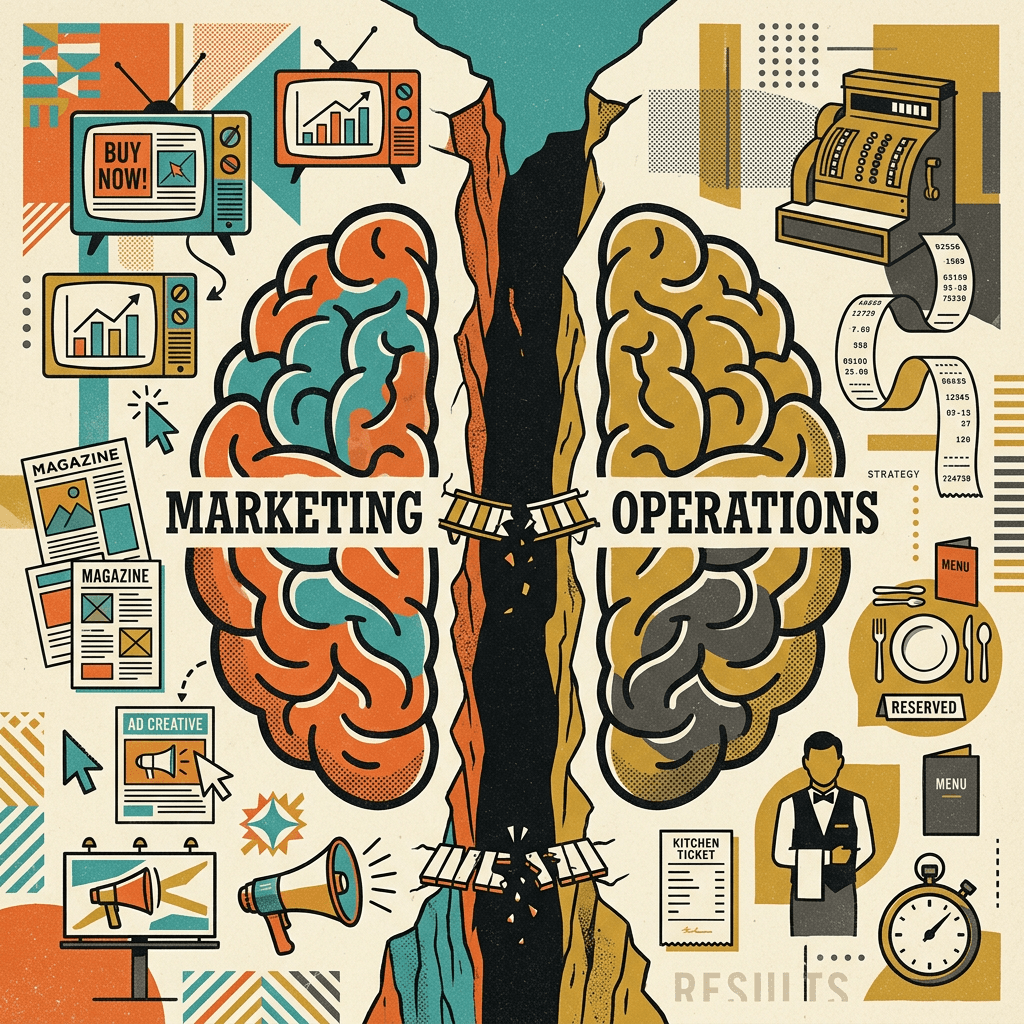
The Two Brains Problem
Every restaurant has two brains that have never been introduced to each other.
The Marketing Brain: Your ads, your website, your social media, your email list. These tools live on the internet. They're built to generate attention and attract guests.
The Operations Brain: Your POS, online ordering, reservation system, loyalty program. These tools live in your restaurant. They're built to process transactions.
The canyon between these two brains is where attribution goes to die.
Your marketing brain knows someone clicked an ad. Your operations brain knows someone paid for a meal. But nobody can prove they're the same person.
Vitamins vs. Fast Food
Every ad platform — Meta, Google, all of them — is an optimization machine. Genuinely brilliant. But only when you feed it real data.
"Good, clean, accurate data is like vitamins for these platforms. It's what makes them learn and get sharper. Most of us are feeding them fast food — impressions, clicks, views."
That's the asymmetry. E-commerce feeds ad platforms revenue data. Restaurants feed them junk calories. Not because restaurant owners are doing it wrong — because the operations tools were never built to pass conversion data back to an ad platform. They were built to process transactions. Period.
The machine can't learn from junk.
What Manual Attribution Actually Looks Like
Here's what I've been doing to try to crack this for the restaurants I work with:
Every quarter, I sit down and literally ask for numbers. Pull reservations from OpenTable. Revenue from the POS. Lead counts from the CRM. Then stitch together four metrics by hand:
- Cost Per Guest Acquired — tying actual reservations back to lead lists. For most of the restaurants I've tracked, this lands between $8 and $25. The industry doesn't even have a benchmark because almost nobody measures it.
- Guest Lifetime Value — dividing total revenue by total guests. At a full-service restaurant averaging $55 per visit and 4 visits per year, that's $220 annually — $660 over three years. One guest. From one ad click you currently can't track.
- Lifetime Profit Per Guest — factoring in margins. On a 15% net margin, that $660 becomes roughly $99 in actual profit per guest. Multiply by 50 new guests a month and you're looking at $59,400 in profit over three years from a single month's acquisition.
- First-Time Guest Attrition Rate — tracking who comes back and who doesn't. I've been seeing 60-70% of first-time guests never return. Which means the ones who DO come back are carrying the entire model.
It's manual. It's not automated. I've built spreadsheets specifically for this.
And I've been obsessed with restaurant attribution for a decade. If I can't automate it, the problem is structural — not personal.
What the Solution Would Need to Look Like
I don't have the full answer yet. But I know the shape of it.
It's not another dashboard. Not another platform to log into. It's a bridge between the two brains.
Something that takes what happens at the register — a real transaction, a real guest, a real dollar amount — and feeds it back to the ad platform as a conversion signal. So the machine can learn who your best guests are and go find more people like them.
The technical pieces exist. Toast and Square have APIs. Meta has the Conversions API. Google has Offline Conversion tracking. The challenge is connecting them in a way that works for independent restaurants — not just enterprise chains with engineering teams.
Shopify gave e-commerce that bridge on day one. One integration. One checkout. One clean data loop.
Restaurants are still waiting for theirs.
What You Can Do Right Now
While the industry catches up, here's where to focus:
Get your baseline numbers. Even if the data is messy, knowing your approximate Cost Per Guest Acquired and Guest Lifetime Value puts you ahead of 90% of restaurant operators. The Guest Getter Growth Planner can help you map these out.
Feed the platforms better data where you can. If your reservation system or ordering platform has any integration with Meta or Google — even a basic one — turn it on. Imperfect conversion data is still better than impressions.
Stop judging campaigns on clicks. Clicks don't pay rent. Track what you can at the register level, even if it's manual and quarterly. A rough number beats a precise vanity metric.
A Shopify store knows exactly which ad sold that $34 candle. Your restaurant still can't tell which ad brought in last Friday's 200-person night.
That gap won't close overnight. But now you know it's not a gap in your skills — it's a gap in the infrastructure. And naming the two brains problem is the first step to bridging it.
I'll keep you posted on what I find.